Do Tubular Skylights Work on Cloudy and Rainy Days?
3 min read ·
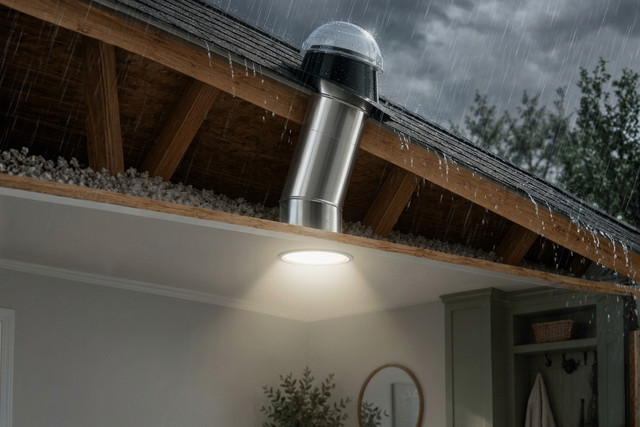
Yes. Solatube systems bring daylight indoors even on cloudy days, but output is lower than on a sunny day. Raybender® 3000 dome technology redirects low-angle sunlight, and the tubing is designed for minimal light loss. Expect a noticeable difference between a clear day and a heavy overcast one.
Gray skies and storms do not mean a dark house. Here is what a tubular skylight does in clouds, rain, snow and winter cold, based on Solatube’s published product information.
How a tubular skylight handles clouds
The dome’s Raybender® 3000 technology redirects low-angle morning, evening and winter sunlight into the system. Spectralight® Infinity tubing then carries that light down with minimal loss, even on cloudy days. Solatube is clear about the limit: light output is always relative to the light available outside, so a heavily overcast day is noticeably dimmer than a sunny one. Berkeley Lab researchers tested commercially available tubular daylight devices under clear, partly cloudy and overcast skies, and found that on clear days light levels rise with the sun’s height and with tube diameter [1]. The Australian Government’s YourHome guide adds that tubular skylights work best where clear, sunny days are common, and that on cloudy days they admit considerably less daylight than a large conventional skylight [2].
Rain, snow and winter cold
- Rain. The dome is round, so water does not collect on it, and the seamless one-piece flashing is designed to let runoff flow past the system. The Department of Energy says leaks are a common problem with improperly installed skylights and recommends a curb, flashing and thoroughly sealed joints [3].
- Snow. Snow on the roof around the dome can raise light output because it reflects light. Snow covering the dome lowers output, but the dome keeps performing.
- Winter cold. The dome optics are designed to collect low-angle sunlight, which matters in northern latitudes. In extreme cold, installers can wrap the tubing in insulation.
Simple steps for peak performance
- Plan for dark days. Keep your regular lights on during heavy storms, because daylight output drops with the sky.
- Check from the ground. Solatube describes the system as virtually maintenance-free, with a dome and flashing designed to avoid debris build-up. After severe weather, look for damage from the ground and call a Premier Dealer instead of climbing onto a wet roof.
- Manage moisture. Condensation is mainly a winter problem and can be worse where ventilation is poor. Ventilating steamy rooms helps.
- Ask about placement. A system works well on the north side of a roof, but it performs better with direct sunlight, so ask your installer where it will get the most.
Safety note: Never climb onto a wet, icy or snowy roof. Wait for dry, calm conditions, or hire a professional. NIOSH says to stop work at height when winds reach 25 to 30 mph, and notes that falls, most often from roofs, ladders and scaffolds, are the leading cause of construction worker deaths [4].
Which Solatube for all seasons?
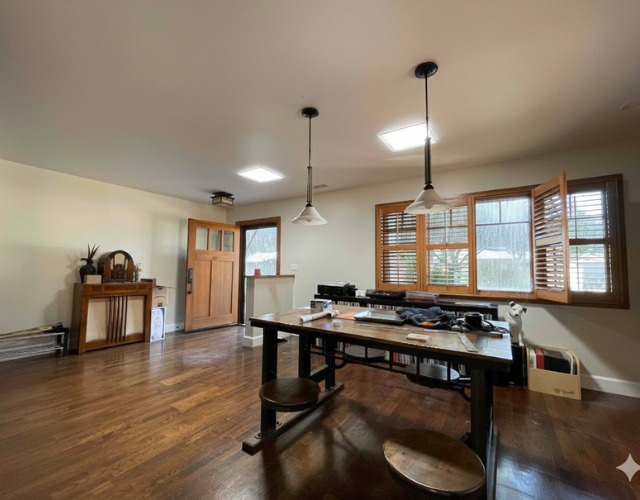
The Solatube 160 DS suits a small, dim room, and Solatube lists it for bathrooms, laundry rooms, closets and hallways.
The Solatube 290 DS is the larger option, listed for kitchens, family rooms, master bathrooms, garages and rooms with high ceilings.
Frequently asked questions
Will a Solatube work when it is raining?
Yes. It brings in the daylight that is available, though output is lower on a heavily overcast day than on a sunny one.
What if snow covers the dome?
Light output drops while snow covers the dome, but the dome keeps performing. Snow on the surrounding roof can raise output because it reflects light.
Want daylight in a room with no window?
Send your room and roof details to a Solatube specialist, or find a Premier Dealer near you.
References
- Fernandes LL, Regnier CM. “Lighting and visual comfort performance of commercially available tubular daylight devices.” Solar Energy 251:420–437, 2023 (Lawrence Berkeley National Laboratory). Accessed October 30, 2026. https://www.sciencedirect.com/science/article/abs/pii/S0038092X23000282
- Australian Government, Department of Climate Change, Energy, the Environment and Water. “Skylights and roof windows.” YourHome. Accessed October 30, 2026. https://www.yourhome.gov.au/passive-design/skylights
- U.S. Department of Energy. “Skylights.” Energy Saver. Accessed October 30, 2026. https://www.energy.gov/energysaver/skylights
- National Institute for Occupational Safety and Health (CDC). “Falls Campaign 2022: Making Research Work.” NIOSH Science Bulletin, April 13, 2022. Accessed October 30, 2026. https://www.cdc.gov/niosh/bulletin/2022/falls-campaign.html